
HOTCOIN Logo
Buy Crypto
Market
Trade
Futures
Earn
Rewards Hub
More
Web3 Wallet
Service Contacts

[email protected]

Product Feedback

[email protected]

Business Cooperation

[email protected]

Legal Contacts

[email protected]

Contact us
Service Contacts

[email protected]

Product Feedback

[email protected]

Business Cooperation

[email protected]

Legal Contacts

[email protected]

About us
Platform Introduction
Announcement Center
System Status
User Agreement
Privacy Policy
Legal Description
Products
Futures
Spot
Copy Trading
Margin
Earn
Trade Crypto via P2P
Buy Crypto with Card
Web3 Wallet
Service
Live Streaming
Hotcoin Elite Picks
Rewards Center
Friend Referral
VIP Benefits
Download
P2P Merchant Application
Support
Hotcoin Academy
Help Center
API Docs
Fee Rate
Crypto Info
Listing Application
Online Service
User Feedback
Official Verification
Trading
BTC USDC
ETH USDC
BTC USDT
ETH USDT
PI USDT
SOL USDT
XRP USDT
©2017-2026
Help Center
/Spot Trading/Spot Trading/
What Is a Trailing Stop Order?
Help Center
/Spot Trading/Spot Trading/
What Is a Trailing Stop Order?

What Is a Trailing Stop Order?

Hotcoin
Share


I. What Is a Trailing Stop Order?


A Trailing Stop Order is a type of conditional order that dynamically adjusts its trigger price based on market movements.

Unlike a standard trigger order, its trigger price automatically moves as the market price shifts in a favorable direction. The order is only executed when the price reverses by a predefined callback rate.


In simple terms:

When the price moves in a favorable direction → the order remains inactive while the trigger price adjusts accordingly
When the price reverses → the order is executed once the callback level is reached


II. How Does a Trailing Stop Order Work?


A trailing stop order uses two key parameters: the activation price and the callback rate.

Once the market price reaches the activation price, the system begins tracking subsequent price movements. As the market moves in a favorable direction, the reference price is continuously updated. When the price reverses by the specified callback rate, the order is triggered and executed as either a limit order or a market order.

Please note that the reference price only moves in a favorable direction and does not adjust if the market moves against the position.


III. Buy and Sell Mechanics


Sell Orders:

When the price rises, the reference price moves up accordingly, maintaining the set callback distance. When the price falls by the set percentage, a sell order is triggered.


Buy Orders:

When the price declines, the reference price moves down accordingly. When the price rebounds by the set percentage, a buy order is triggered.


IV. Example


Sell Example:

Assume the current BTC price is 8,000 USDT, with a callback rate of 5%, an activation price of 8,500 USDT, and a limit order price of 8,400 USDT.

  • If the market price has not reached 8,500 USDT, the trailing stop order remains inactive.
  • When the price rises to 8,500 USDT, the order is activated, and the system begins tracking the highest price thereafter.
  • If the price continues to rise to 9,000 USDT, this becomes the reference high. If the price then drops by 5% from the peak (approximately 8,550 USDT), the sell order is triggered.
  • Once triggered, the order is placed at 8,400 USDT. As this price is lower than the market price at the time of triggering, it is more likely to be filled, helping lock in profits.


Buy Example:

Assume the current BTC price is 9,500 USDT, with a callback rate of 5%, an activation price of 9,000 USDT, and a limit order price of 9,100 USDT.

  • If the market price has not fallen to 9,000 USDT, the trailing stop order remains inactive.
  • When the price drops to 9,000 USDT, the order is activated, and the system begins tracking the lowest price thereafter.
  • If the price continues to fall to 8,000 USDT, this becomes the reference low. If the price then rebounds by 5% from the low (approximately 8,400 USDT), the buy order is triggered.
  • Once triggered, the order is placed at 9,100 USDT. As this price is higher than the market price at the time of triggering, it is more likely to be filled, helping capture the rebound.


V. Setting Up a Trailing Stop Order


A trailing stop order requires the following parameters:
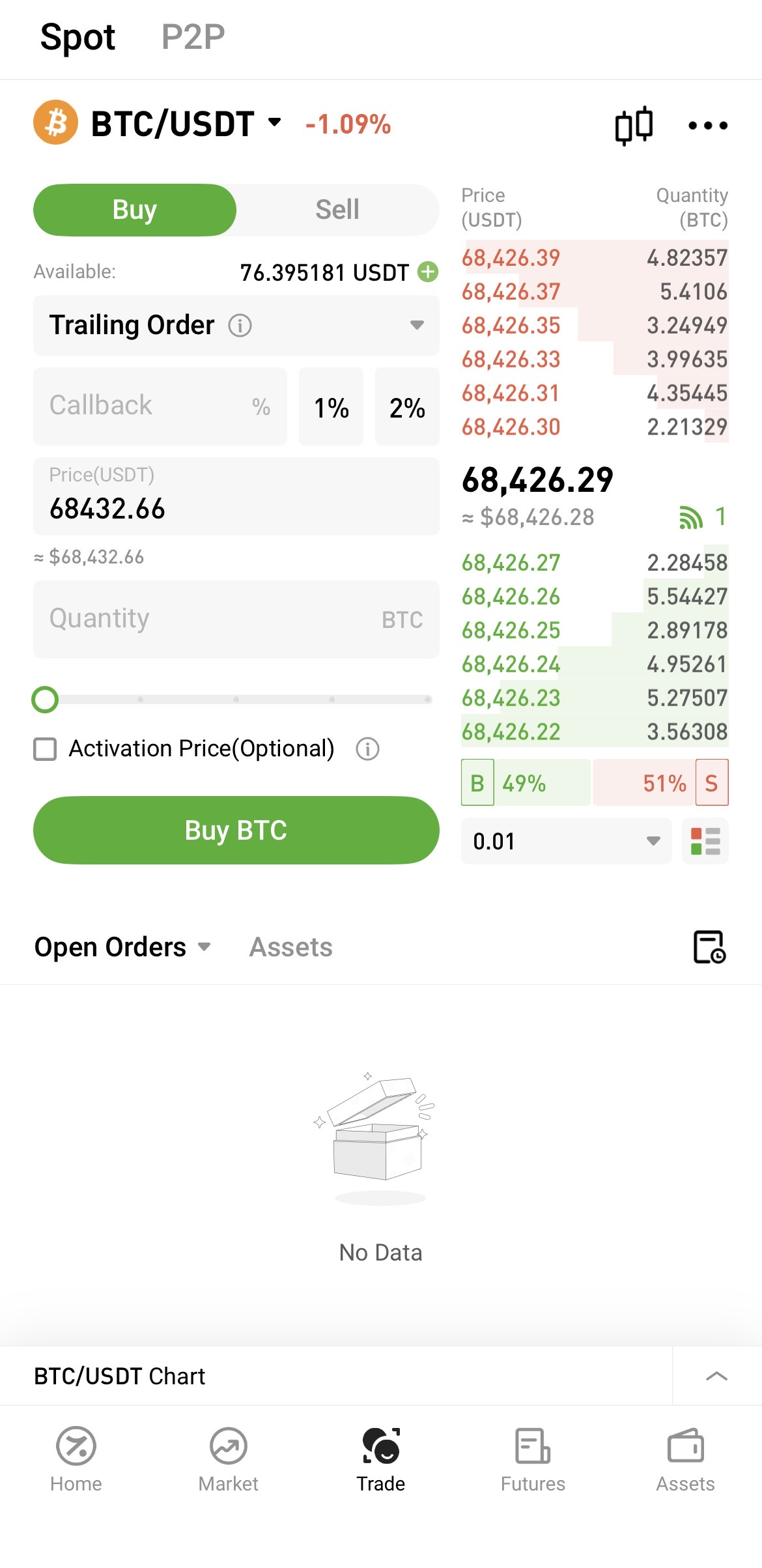
1. Callback Rate: The percentage of price reversal allowed, typically ranging from 0.1% to 20%.
2. Order Price (Limit/Market) : Determines how the order will be executed once triggered. Users can choose either a limit order or a market order.
3. Quantity: The order size to be placed once triggered.
4. Activation Price (Optional): The price that activates the trailing mechanism. If not set, the current market price will be used as the default activation condition.


VI. Important Notes


The effectiveness of a trailing stop order depends on how its parameters are set:

  • A callback rate that is too small may be triggered by normal market fluctuations, leading to premature execution
  • A callback rate that is too large may delay execution until after a significant pullback
  • An activation price set too close may result in frequent triggering
  • An activation price set too far may lead to missed entry or take-profit opportunities


In highly volatile markets, it is recommended to use a larger callback rate. In more stable market conditions, a smaller callback rate may be more appropriate.

As market conditions change, users are encouraged to adjust their settings accordingly.

Quick Start Guide
Cryptocurrency Basics
Beginner’s Guide
App Guide
Start Trading
VIP Program
Rewards Center
Account Security & KYC
Asset Security
Security Settings
KYC Verification
Deposit & Withdrawal
Deposit
Withdrawal
P2P
P2P Trading Guide
P2P Merchant Management
P2P Rules & Agreements
Friend Referral
Spot Trading
Spot Trading
Pre-market trading
Derivatives
Advanced Trading
Grid Trading
Trend Trading
Fundamentals of Technical Analysis (Candlesticks / MACD / RSI)
Prediction Market
Futures Grid
Futures Trading
Getting Started
Contract Type
Trading Mechanics
Risk Management
FAQ
Copy Trading
Getting Started
Follower Guide
Lead Trader Guide
Terms of Service
Web3 Wallet
Getting Started
Swap
Hotcoin Card
Hotcoin Earn
Alpha
Startup
Platform Support
Agreements & Rules